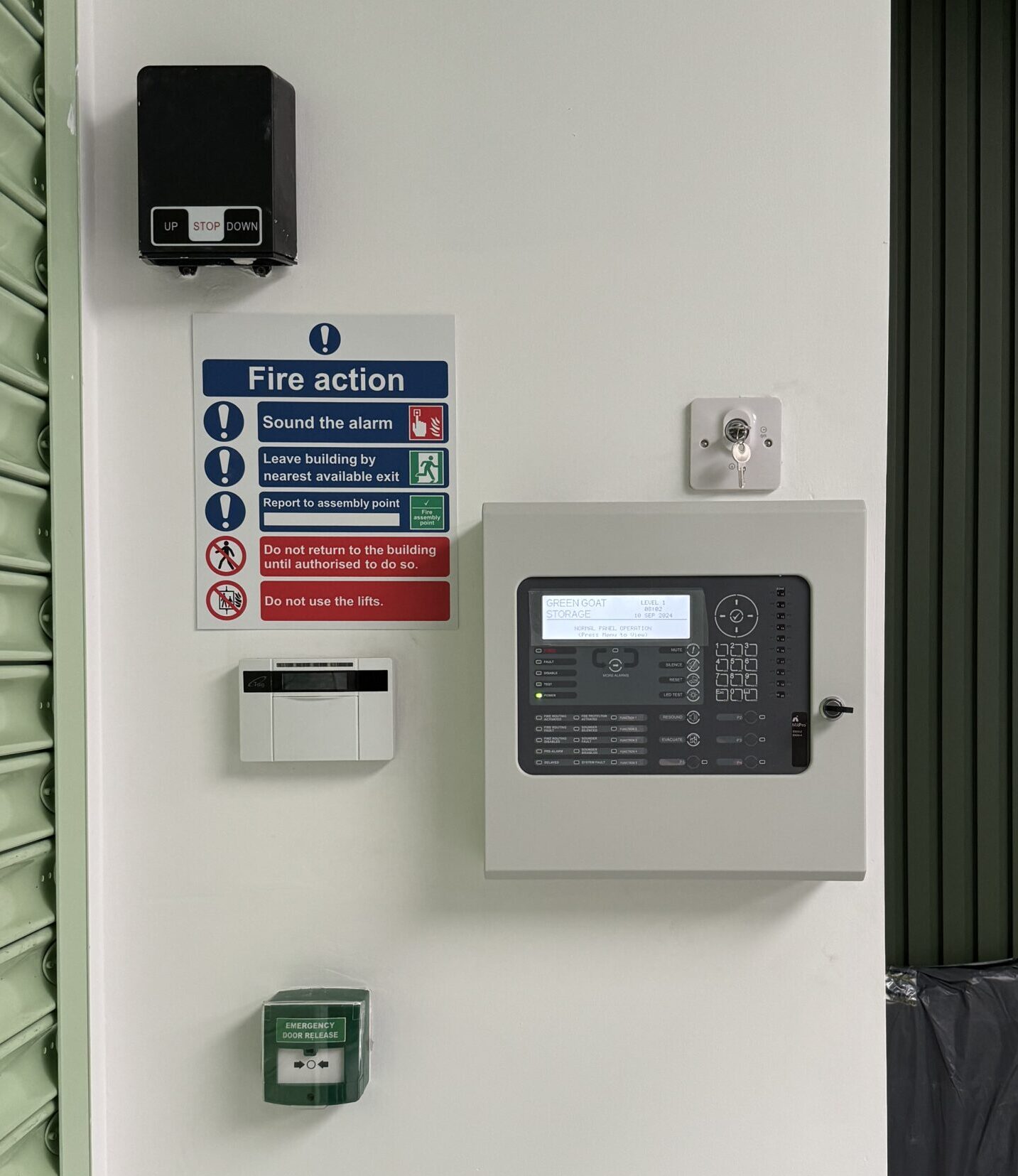
If you manage a commercial building, your fire alarm needs a professional service every six months and a quick test from you every week. That is the short answer. The detail matters though, because BS 5839-1 was updated in 2025 and fire services across the UK have changed how they respond to automatic alarms. This guide explains what you need to do, what your engineer should do and what it costs you if servicing slips.
How often your fire alarm needs a service
BS 5839-1 is the British Standard for fire detection and alarm systems in non-domestic buildings. It recommends that a competent engineer inspects and services your system at intervals of no more than six months. The Fire Industry Association is clear that if you go beyond this, your system no longer complies with the standard.
What changed in BS 5839-1:2025
The 2025 edition, published on 30 April 2025, keeps the six month interval but gives you a sensible window. Your service now counts as on time if it happens any time between five and seven months after the last one. The clock starts from the date your system was handed over, not from whenever someone last remembered to book a visit. The new edition also adds rules for remote servicing, so any engineer who connects to your panel remotely must authenticate first and confirm the system is fully working afterwards. Read our full guide to what changed in BS 5839-1:2025 for the other changes.
Is six monthly servicing a legal requirement?
The law does not name a number of months. In England and Wales, the Regulatory Reform (Fire Safety) Order 2005 requires the responsible person to keep fire safety equipment maintained in efficient working order and good repair. Scotland and Northern Ireland have equivalent duties. BS 5839-1 is how you prove you meet that duty, and it is the benchmark fire inspectors and insurers use. In practice, six monthly servicing is what the law expects of you.
Your weekly fire alarm test
Between services, the job falls to you. BS 5839-1 recommends a test every week, carried out by someone on site such as a facilities manager or a trained member of staff. It takes a few minutes.
How to carry out the weekly test
- Pick a different manual call point each week, so every call point gets tested over time.
- Test at roughly the same time each week, so staff know it is a test and not a real alarm.
- If your system sends signals to an alarm receiving centre, call them first to put it on test.
- Operate the call point with the test key and check the panel shows the right location.
- Check the sounders and beacons work across the building.
- Reset the panel and record the test in your logbook.
Keep your logbook up to date
Your logbook is the first thing an inspector or insurer asks to see. Record every weekly test, every false alarm, every fault and every service visit. Under the 2025 edition, all agreed variations from the standard must now go in the logbook too, not just the major ones.
What happens during a six monthly service
A proper service is far more than pressing a button and leaving. Your engineer should work through a set of checks on every visit, and make sure every device in the building gets tested across each 12 month period.
Checks on every visit
- Review your logbook, including any false alarms since the last visit and what caused them.
- Inspect the control panel, check its clock and test its fault and alarm functions.
- Test standby batteries and the charger.
- Test a sample of detectors, call points and sounders.
- Confirm signals reach your alarm receiving centre correctly, a check the 2025 edition now makes explicit.
- Leave any unresolved fault showing on the panel, never hidden, so you know about it.
Checks across the year
Over 12 months, every detector, call point and sounder should be functionally tested. The 2025 edition adds two annual checks: confirming that the zones shown on the panel match your zone plan, and testing any smoke detectors fitted in ventilation ducts. At the end of each visit you should receive a servicing certificate. Keep it with your logbook.
Why skipping a service costs you more
An unserviced system is far more likely to raise false alarms or fail when you need it. Both cost you money, and one could cost lives.
False alarms are now your problem
In the year ending March 2026, fire and rescue services in England attended 255,047 fire false alarms. That is 40% of every incident they went to, according to Home Office figures. Around two thirds of those, 172,247 calls, were caused by alarm equipment itself rather than by people or malicious calls. Poorly maintained detectors are one of the most common causes.
Fire services have responded by cutting how often they attend. Since October 2024, London Fire Brigade no longer attends automatic alarms at most offices and non residential buildings between 7am and 8:30pm unless someone confirms a fire. The Brigade attended around 52,000 false alarms from automatic systems in a single year, and 99% turned out not to be fires. Assistant Commissioner Craig Carter explained that the change gives firefighters “more time to focus on protection and prevention activity”. Many other services now have similar policies, which means a reliable, well maintained system and a clear plan for checking alarms matter more than ever.
Insurance and enforcement
Most commercial insurance policies expect your fire alarm to be maintained to BS 5839-1. After a fire, an insurer will ask for your service certificates and logbook. Gaps give them grounds to reduce or refuse a claim. Fire safety inspectors can also issue enforcement notices if your system is not maintained, and serious failings can lead to prosecution.
Domestic and residential fire alarms
Homes and residential buildings follow BS 5839-6 instead, and the rules depend on the type of system.
Smoke alarms in your home
Mains powered smoke and heat alarms with battery backup, known as Grade D systems, should be tested by the occupant at least once a month by pressing the test button. Replace each alarm by the date the manufacturer gives, usually after ten years.
Flats, HMOs and blocks with a control panel
Larger residential buildings often have a panel based Grade A system covering the communal areas. These are serviced by a competent engineer in the same way as a commercial system, at intervals of no more than six months. High rise residential buildings may also have an evacuation alert system, which needs its own regular testing and servicing to BS 8629.
Choosing who services your fire alarm
BS 5839-1 says servicing must be carried out by a competent person. The simplest way to know you have one is third party certification.
Look for BAFE SP203-1 or LPS 1014
The Fire Industry Association recommends using a company that holds BAFE SP203 or LPS 1014 certification. These schemes independently audit a company’s engineers, paperwork and quality of work. Using a certificated company gives you clear evidence that you took reasonable steps to meet your legal duty.
Advantage Technical Services is BAFE SP203-1 accredited and has serviced fire alarm systems across Hertfordshire, Bedfordshire, London and nationwide since 2004. We service all major panel brands and handle everything from commercial fire alarms to evacuation alert and refuge systems. Get in touch to book your next service or to take over maintenance of an existing system.
Frequently asked questions
How often should a fire alarm be serviced in the UK?
Every six months. BS 5839-1:2025 counts a service as on time if it falls between five and seven months after the previous one.
Who is responsible for fire alarm maintenance?
The responsible person for the building. That is usually the employer, the building owner or the managing agent. You can hire an engineer to do the work, but the legal duty stays with you.
How often should I test my fire alarm?
Once a week, using a different manual call point each time, and record every test in your logbook.
Can I service my own fire alarm?
You can and should carry out the weekly test yourself. The six monthly service must be done by a competent person, ideally from a BAFE SP203 or LPS 1014 certificated company.
What happens if my fire alarm is not serviced?
Your system no longer complies with BS 5839-1. You risk more false alarms, enforcement action from the fire service and problems with your insurance if you ever need to claim.
Do smoke alarms in my home need servicing?
Test them yourself at least once a month and replace them by the manufacturer’s date. Panel based systems in flats and HMOs need a professional service every six months.

No responses yet